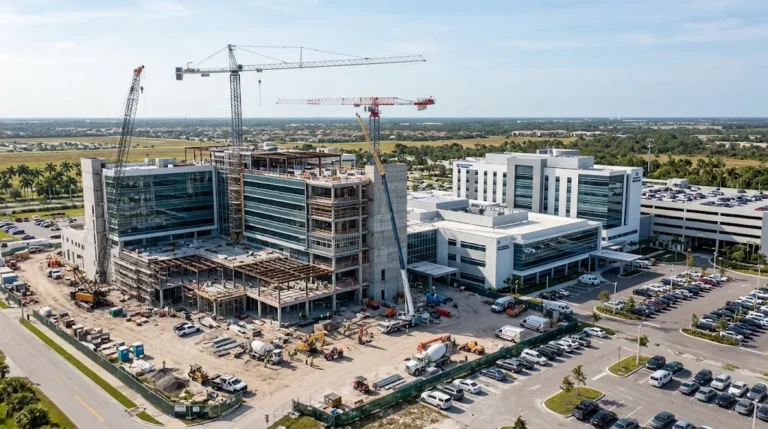
Photo: Will Forrester via Unsplash (Unsplash License).
Quick Answer: Port St. Lucie’s City Council adopted a $971.6 million operating and capital budget for fiscal year 2026-27 in late September, cutting the city’s total property tax rate from 4.9750 to 4.8750 mills, the 11th straight annual reduction. The spending plan leans heavily on water, sewer and road projects, while voters’ Nov. 3 approval of Amendment 3 now puts tens of millions of dollars in future city property tax revenue at risk.
Port St. Lucie entered fiscal 2026-27 on Oct. 1 with a larger budget, a lower tax rate and a capital program built around water, sewer and road capacity. Five weeks later, Florida voters approved a constitutional amendment that sharply expands the homestead exemption, changing the outlook for every budget that follows. Figures below are as of mid-November 2026.
What did Port St. Lucie adopt for fiscal year 2026-27?
The City Council unanimously approved a $971.6 million budget covering operating and capital funds at its final public hearing on Monday, Sept. 28, 2026, according to WPTV. The budget took effect Oct. 1. In the same action, the council lowered the city’s total millage rate to 4.8750 mills, down from 4.9750 in fiscal 2025-26, a cut of one-tenth of a mill.
The adopted total is slightly below the $975.3 million that City Manager Jesus Merejo proposed over the summer. The proposed budget in brief described that figure as a 12.12% increase over fiscal 2025-26. The prior year’s adopted budget was about $869.8 million, according to WPTV’s coverage of the September 2025 vote, so the adopted fiscal 2026-27 total is roughly 11.7% higher.
| Key fact | FY 2025-26 | FY 2026-27 |
|---|---|---|
| Total budget, all funds | $869.8 million (adopted) | $971.6 million (adopted); $975.3 million proposed |
| Total city millage | 4.9750 | 4.8750 |
| Taxable value (preliminary) | $25.5 billion | $26.9 billion (+5.45%) |
| Proposed General Fund | About $212.5 million | $230.6 million (+8.48%) |
| Year-one capital budget (proposed) | n/a | $225.8 million; $244 million with stormwater and golf |
| Full-time equivalent positions (proposed) | n/a | 1,550.25 |
| Projected outstanding debt | n/a | $765 million (peak was $1.042 billion in FY 2009-10) |
Source: City of Port St. Lucie FY 26/27 Proposed Budget in Brief; City of Port St. Lucie Proposed CIP FY 2027-2036; WPTV. The FY 2025-26 General Fund figure is derived from the city’s stated $18 million, 8.48% increase.
How much did the property tax rate fall, and what does it mean for a tax bill?
The council first set the 4.8750 rate as a tentative maximum at its summer workshop on July 23, 2026, then confirmed it at the September hearings. WQCS reported that the council chose a larger cut than city staff had recommended, over the objection of the city manager, who pointed to uncertainty about the statewide property tax amendment then headed for the November ballot.
Budget Director Caroline Sturgis told the council that a 0.10-mill reduction equals about $2.6 million in lost revenue, according to WQCS. She said reserves would cover the reduction in the first year; the Crosstown Parkway reserve stood at about $12 million against an annual Crosstown debt payment of about $8.2 million.
How does the new rate compare with past years?
The city’s total millage was 6.6289 in fiscal 2015-16. It has fallen every year since; it was 5.0550 in fiscal 2024-25. The city says it has cut the rate 25% since 2016, saving the average homeowner nearly $2,000 over 10 years, and that it has the third-lowest municipal tax rate among Florida’s 20 largest cities.
How much of a Port St. Lucie tax bill goes to the city?
Less than many residents assume. The city’s tax bill guidance says the city operating levy and the voter-approved debt line together make up about 21% of a typical bill. The rest goes to six other taxing authorities, including St. Lucie County, the school district and the St. Lucie County Fire District. In the city’s example for fiscal 2026-27, an average resident with an assessed value of $243,009 and a homestead exemption of $51,411 pays about $4,381 in total property taxes, of which about $934 goes to the city.
For a commercial property, which does not get a homestead exemption, the math is direct: at 4.8750 mills, each $1 million of taxable value carries $4,875 in city tax, compared with $4,975 at last year’s rate, a savings of $100 per million. Because taxable values have been climbing, many owners will still see higher city tax bills even at the lower rate.
How fast is Port St. Lucie’s taxable value growing?
The city’s proposed budget, using the St. Lucie County Property Appraiser’s preliminary estimate from May, put Port St. Lucie’s taxable value at $26.9 billion for fiscal 2026-27, up from $25.5 billion, a gain of 5.45% from new construction and appreciation.
That is a much slower pace than the city saw earlier in the decade. WPTV reported that the city’s taxable value rose from about $11.8 billion in 2020 to about $25.7 billion in 2025, more than doubling. Syndicated news coverage of the Property Appraiser’s 2023 preliminary roll showed Port St. Lucie’s taxable value up 12% that year, after gains of 17% in 2022 and 19% in 2021.
Slower value growth matters because property taxes are the single largest source of General Fund money. In the proposed budget, property taxes supplied $110.6 million, or 47.96% of General Fund revenue.
Where does the General Fund money go?
Public safety dominates. The proposed General Fund of $230.6 million directed $104.0 million, about 45%, to the Police Department. Parks and recreation received $23.5 million.
CBS12 reported from the July workshop that the police budget would rise nearly 10% to just under $104 million, driven by a 5% contractual raise for sworn officers plus equipment, training and technology, while staffing stays flat at just over 468 positions. The city declined to fund 184 requested positions worth $28.3 million, including 25 police officers, and employees will not receive a cost-of-living raise. The proposed budget showed a net increase of only seven positions, all in the Utility System Fund, for a total of 1,550.25 full-time equivalents.
What capital projects are in the plan?
The capital side is where the budget’s growth is concentrated. The city manager’s April 13, 2026, budget message for the fiscal 2027-2036 capital improvement program described a five-year plan of $990.3 million covering 238 projects, rising to about $1.1 billion with stormwater and golf course projects that are funded through operating budgets. The proposed year-one capital budget for fiscal 2026-27 was $225.8 million, or $244 million including stormwater and golf.
The city’s budget-in-brief grouped the five-year program at $1.069 billion, as shown below.
| Five-year capital category | Amount |
|---|---|
| Utility system upgrades | $672.7 million |
| Other projects | $276.4 million |
| Walton & One, Torino and Tradition regional parks, O.L. Peacock Park | $51.1 million |
| Facilities maintenance | $34.8 million |
| Street resurfacing | $24.5 million |
| Sidewalk projects | $9.9 million |
| Total | $1.069 billion |
Source: City of Port St. Lucie FY 26/27 Proposed Budget in Brief.
Which utility projects are the largest?
Water and sewer capacity accounts for nearly two-thirds of the five-year program. In the proposed capital plan, the Utility CIP fund carries $672.7 million over five years, with $141.3 million in fiscal 2026-27. The biggest single item is the Glades Wastewater Treatment Plant expansion, budgeted at $320 million from fiscal 2027 through 2031. The Discovery Road reverse osmosis water treatment plant is budgeted at $139.9 million over fiscal 2027 to 2029, including $37.7 million in the first year, along with a $35 million injection well system and an $8 million raw water main.
Which road projects are funded?
Roads are financed largely through the Road and Bridge fund ($69.3 million over five years, $48.3 million in fiscal 2026-27) and the Half-Cent Sales Tax fund ($122.5 million over five years). Named projects in the proposed plan include:
- Port St. Lucie Boulevard South, Segment 1 (Becker Road to Paar Drive): $27.3 million in fiscal 2026-27, plus $2.5 million for related utility work.
- St. Lucie West Boulevard widening (Peacock Boulevard to Cashmere Boulevard): $88.6 million in total.
- Gatlin Boulevard/Savona Boulevard Phase II widening: $11.5 million in fiscal 2026-27.
- California Boulevard widening: $18.05 million over fiscal 2027 to 2029.
Stormwater has its own track. The Stormwater fund shows $74.8 million over five years, including a $30 million Oak Hammock watershed improvement, supported in part by a $6 increase in the annual residential stormwater fee.
What got cut from the capital list?
The April capital plan included a $2 million study for a Marshall Parkway interchange at Interstate 95 and bond-financed City Hall expansion and parking garage projects. By the July workshop, CBS12 reported that the city had canceled $7.8 million in capital projects, including the Marshall Parkway interchange study, an inclusive playground at McChesney Park, parking improvements at Riverland Paseo Park and construction of a new City Hall and parking garage.
The capital plan also identifies $783.9 million in long-term bond financing needs over fiscal 2027 to 2031. The city projects outstanding debt of $765 million in fiscal 2026-27, split between $390 million in governmental activities and $375 million in business-type activities such as utilities, down 26.58% from the fiscal 2009-10 peak of $1.042 billion.
What does the budget mean for Port St. Lucie businesses?
Property taxes and fees
Commercial owners benefit from the lower millage, but fees moved the other way. The proposed budget raises water rates 3.5%, keeps sewer rates unchanged, raises the residential stormwater fee by $6 to $195 per year with a vacant-property rate of $147.75, and sets the solid waste assessment at $482.16.
Construction and contracting
A capital program of roughly $1 billion over five years represents a sustained pipeline of public construction, engineering and supply contracts. Projects such as the Discovery Road water plant and Glades wastewater expansion add utility capacity that new commercial and residential development depends on. WPTV reported that more than 60,000 new residents have moved to the city since 2020, driving the need for roads, drainage, utilities and public safety.
How does Amendment 3 change the outlook?
Florida voters approved Amendment 3 on Nov. 3, 2026, with about 62% of the vote, above the 60% threshold, according to WEAR and Spectrum News 13. The amendment raises the homestead exemption for non-school property taxes from $50,000 to $150,000 in 2027 and to $250,000 in 2028, with inflation adjustments after that. WEAR reported that it also lowers the annual assessment increase cap on non-homestead property, including certain rental and commercial property, from 10% to 5%. School district taxes are not affected.
The city’s own analysis estimated that Amendment 3 would cost Port St. Lucie $26.3 million in the first year and $22.1 million in the second, a total of $48.4 million. The city said about 62% of its residential parcels receive a homestead exemption, compared with 47% statewide, and that it has relatively few commercial and industrial properties to offset the loss. The changes take effect Jan. 1, 2027, and will first show up in 2027 tax notices and the city’s fiscal 2027-28 budget.
The fiscal 2026-27 budget is not directly affected, but the city has already described steps it took in preparation, including hiring freezes, deferred capital projects, suspended salary adjustments, restricted overtime and limited travel. Countywide, WQCS reported that St. Lucie County projects revenue losses of about $63 million in the first year and roughly $112 million in 2028.
Could businesses end up paying more?
That is the open question. Local governments can respond with cuts, new fees or assessments. WQCS reported that in neighboring Martin County, a preliminary analysis found a roughly 19% tax increase on non-homesteaded property would cover that county’s first-year gap, though a commissioner doubted it would be adopted. How Port St. Lucie balances its fiscal 2027-28 budget will determine how much of the burden shifts to commercial property and fees.
Frequently Asked Questions
What is Port St. Lucie’s total budget for fiscal 2026-27?
The City Council adopted a $971.6 million budget covering operating and capital funds on Sept. 28, 2026. It took effect Oct. 1, 2026.
What is the city’s millage rate for 2026-27?
The total city millage rate is 4.8750 mills, or about $4.88 per $1,000 of taxable value, down from 4.9750 the year before. It is the 11th consecutive annual reduction.
How much is Port St. Lucie’s taxable value?
The city’s proposed budget, based on the Property Appraiser’s preliminary May estimate, put taxable value at $26.9 billion, up 5.45% from $25.5 billion.
How will Amendment 3 affect the city?
The city estimated a revenue loss of $26.3 million in the first year and $22.1 million in the second, or $48.4 million over two years. The impact begins with the fiscal 2027-28 budget.
Do businesses get the new homestead exemption?
No. The larger exemption applies to qualifying primary residences. Non-homestead property, including commercial property, would see its annual assessment cap lowered from 10% to 5%, according to WEAR.
Sources and Further Reading
- FY 26/27 Proposed Budget in Brief — City of Port St. Lucie
- Capital Improvement Projects 2027/2036 Proposed — City of Port St. Lucie
- Port St. Lucie lowers millage rate for 11th straight year — City of Port St. Lucie
- Understand Your Tax Bill — City of Port St. Lucie
- Amendment 3: What Florida Voters Should Know — City of Port St. Lucie
- Port St. Lucie lowers property tax rate for 11th straight year — WPTV
- Port St. Lucie property taxes rising despite lower millage rate as home values more than double — WPTV
- Port St. Lucie lowers millage rate for 11th consecutive year — WQCS
- Amendment 3 passes; Treasure Coast counties brace for budget hits — WQCS/WUSF
- Port St. Lucie would lose over $48 million in revenue if property taxes go away — CBS12
- Amendment 3 passes with 62% of the vote, lowering property taxes and local revenue — WEAR
- Amendment 3 raises Florida homestead exemption starting in 2027 — Spectrum News 13
- Property values up in St. Lucie for 12th straight year, but growth continues to slow — AOL (syndicated)
About the Author