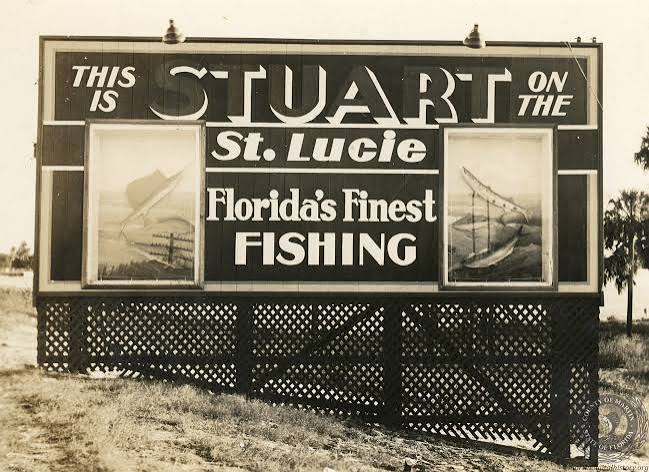
Quick Answer: Pruitt’s Fishing Camp was a riverside fishing retreat run by guide Burt Pruitt on the North Fork of the St. Lucie River, in what is now Port St. Lucie. Built in the early 1940s, it drew anglers, sportswriters and celebrities to a wild, mangrove-lined river. Pruitt sold his 163 acres in 1968, and the camp slipped away in the early 1970s as the new city grew around it.
A River Camp Before There Was a City
Long before Port St. Lucie had traffic lights, shopping centers or a quarter of a million residents, it had a dock, a few cabins and a man who knew every bend of the river. Pruitt’s Fishing Camp sat on the bank of the North Fork of the St. Lucie River, reached by a sandy road through pine woods. Its owner, Burt Pruitt, sometimes called the place his “Fishin’ Farm” and sometimes his “Ranch.” To the people who came back year after year, it was simply Pruitt’s.
Pruitt was born in Georgia in 1904 and came to South Florida as a young man who worked on motorboats and loved to fish. He built a guiding business taking wealthy Palm Beach visitors out for a day on the water, and his guests kept asking to go farther up the St. Lucie because the river was so lovely and the fishing so rich. By the early 1940s he had settled on the North Fork and built the camp that would carry his name for the next three decades.
When General Development Corporation arrived in the late 1950s to plan a new community on tens of thousands of acres of ranch and pine land, the fishing camp was one of the few landmarks already on the map. Histories of the city still describe the pre-development landscape the same way: mostly empty land south of White City, a handful of farms and businesses near U.S. 1, and Burt Pruitt’s camp on the river.
A Sight to Remember: The River From Pruitt’s Dock
What made the camp special was not the cabins. It was the water. The North Fork is a slow, dark, winding river, and in Pruitt’s day it ran through unbroken wilderness. Mangroves crowded the lower banks. Farther up, cabbage palms and old oaks leaned out over the current. Pines stood behind them as far as a visitor could see.
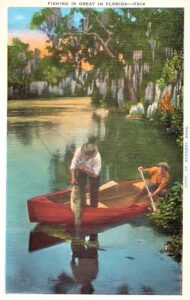
Mornings began with mist lifting off still water and tarpon rolling at the surface, silver backs flashing and gone. Mullet jumped. Herons and egrets worked the shallows, and in a 1952 outdoor column a Fort Pierce sports editor reported watching roseate spoonbills, pink against the green, feeding along the banks at a time when many people believed the birds had nearly vanished from Florida. Wild turkeys moved through the pinelands. Old-timers remembered snakes draped in the branches above the river and epic card games in the cabins at night.
The camp sat at a rare meeting point of two fisheries. Upstream the water ran fresh, and guests caught bass and bream. Downstream it turned brackish and salty, home to snook, tarpon and big bottom fish. An angler could leave the same dock and choose a freshwater morning or a saltwater afternoon. On a good day in the camp’s prime, Pruitt’s parties were said to bring 35 to 45 sport fish to the boat.
Then there were the alligators. Pruitt fed several of them at his dock and called each by name. Visitors wrote about a six-footer named Mike that would break off chasing a smaller gator when Pruitt told him to. It was the kind of story guests carried home and told for years, and it was part of why the camp’s fame traveled well beyond the Treasure Coast.
Evenings were the reward. The river went to glass, the sky turned orange and rose behind the tree line, and the only sounds were an outboard idling home and fish breaking the surface. For a generation of visitors, that view from Pruitt’s dock was their first picture of this part of Florida, and it stayed with them.
Pruitt’s Fishing Camp at a Glance
| Item | Details |
|---|---|
| Owner | Burt Pruitt (1904-1980), fishing and hunting guide |
| Also known as | Pruitt’s Fish Camp, Burt Pruitt’s Fishin’ Farm, Pruitt’s Fishing Ranch |
| Location | Bank of the North Fork of the St. Lucie River, between today’s Port St. Lucie Boulevard and Morningside Boulevard |
| Built | Early 1940s |
| Land | 163 acres along the river, sold to General Development Corporation in 1968 |
| Fishing | Bass and bream upstream; snook, tarpon and saltwater bottom fish downstream |
| Guide fee | About $15 a day in the early years; $50 a trip by 1970 |
| Known for | Pet alligators at the dock, rolling tarpon, wild river scenery |
| Final years | Pruitt left the camp about 1970; the camp closed in the early 1970s |
| Site today | Absorbed into the riverfront community first developed as Tesoro |
The 1970s: A Paradise in Its Last Light
The 1970s were the camp’s farewell decade, and that is what gives the era its bittersweet glow. By then Pruitt was in his late 60s. General Development Corporation had first asked to buy his riverfront in 1962. He held out for six years, sold in 1968, and stayed on at the camp for about two more years before moving away.
In 1970 the incorporated City of Port St. Lucie completely surrounded his pinelands, even though home building had barely started. The census that year counted just 330 residents. Pruitt could see what was coming. “They’re closing in on me,” he told a reporter that year, speaking of the developers.
Skin cancer had forced him out of the sun, so he no longer guided himself and hired other guides to take guests out. A trip that once cost $15 now ran $50, and he said he made less from it than before. The fishing had changed too. Snook, once a year-round catch, were now dependable mainly in May and June, and tarpon had grown scarce. A man who had counted 3,300 birds on the river for the local Audubon chapter in 1968 said he found fewer than 100 two years later. He blamed freshwater releases from Lake Okeechobee and farm chemical runoff.
Yet the river itself was still beautiful, and people who knew the camp in those last seasons remember it that way: the quiet water, the birds that remained, the sense of standing in the last wild corner of a place about to change forever. A newspaper writer looking back in 1970 called it one of the most famous fishing spots in the country in its day.
The decade also brought the river a measure of protection that Pruitt had argued for all his life. In 1972, state, federal and local agencies joined to designate the North Fork of the St. Lucie River an Aquatic Preserve. The camp was ending, but the waterway that made it famous would be kept.
After the camp closed, one of its old cabins found a second life as a news bureau for the Fort Pierce newspaper. A reporter who worked there later recalled the lack of air conditioning and the wildlife that turned up in her desk drawers. Burt Pruitt died in Fort Pierce in January 1980, just as the city he had watched arrive was taking off.
Port St. Lucie Then and Now
| Year | Population | What was happening |
|---|---|---|
| 1958 | Not yet a city | General Development Corporation buys River Park and about 40,000 acres along the North Fork |
| 1961 | Incorporated April 27 | Port St. Lucie becomes a city; a country club opens nearby as a sales center |
| 1970 | 330 | City limits surround Pruitt’s land; the camp is in its final seasons |
| 1980 | 14,690 | Pruitt dies in January; the city forms its own police force |
| 1990 | 55,866 | Rapid residential growth across the former ranch lands |
| 2000 | 88,769 | Riverfront tracts near the old camp are planned for new communities |
| 2010 | 164,603 | Port St. Lucie Botanical Gardens opens on former Pruitt land |
| 2020 | 204,851 | Port St. Lucie ranks among Florida’s largest cities |
| 2024 (est.) | 258,575 | Growth continues west and south |
Few American cities have changed so much in one lifetime. A person who rented a skiff at Pruitt’s dock in 1970 could have met most of the city’s residents in an afternoon. Today the same river runs through the middle of one of the largest cities in Florida.
Famous Guests and a National Reputation
For a small camp at the end of a sand road, Pruitt’s had a remarkable guest list. Members of the Rockefeller family made trips to South Florida to fish with him. A 1970 account named singer Perry Como, baseball great Ted Williams and golfer Jack Nicklaus among the visitors. Como had a local tie: the first Perry Como Amateur Invitational golf tournament was played in Port St. Lucie in 1961.
Outdoor writers loved the place. In 1958 the Outdoor Writers Guild of Florida spent a weekend at the camp and came away praising Pruitt as a genuine asset to St. Lucie County. Martin County newspaperman Ernest Lyons, one of Florida’s best-known river writers, brought his family to Pruitt’s in the 1940s and early 1950s, renting a skiff and motoring to the spot where two branches of the North Fork come together.
That press attention worked like free advertising for the whole region. Years before developers ran their first promotions, stories about tarpon, snook and tame alligators on the North Fork were telling readers across the country that this stretch of Florida was worth the trip.
The River Keeper
Pruitt was more than a host. He was an honorary warden for the state Game and Fresh Water Fish Commission, which had set the North Fork aside as a wildlife sanctuary. In the early 1950s he helped authorities chase off poachers running illegal nets in the river, an operation that ended with about $3,000 in gear seized, and he reported people shooting in the preserve.
He was a complicated man. Local historians have documented a turbulent personal life and some dark chapters in the camp’s early years. But on one subject he was steady for half a century: the river deserved protecting. When the lower North Fork was dredged and deepened for the new community, he worried, then conceded in 1962 that the fishing was still excellent. By 1970 he was warning anyone who would listen about what drainage and runoff were doing to the water. Many of the concerns he raised are the same ones Treasure Coast residents debate today.
What Became of the Land
The actual campsite is gone. It was absorbed into the riverfront golf community first developed as Tesoro in the early 2000s. Until then, the spot could still be reached from the old Wilderness golf course at the Sandpiper Bay resort, where visitors found old foundations, gnarled fruit trees and tarpon still rolling near the bank.
Other pieces of Pruitt’s riverfront took different paths. City records show the land under the Port St. Lucie Botanical Gardens was once part of the Pruitt Fish Camp. That tract was approved in 1981 for a 374-home project called Moonraker Bay, but only roads and utilities were ever built. The city bought it in 2002 with county help and state conservation grant money, and the gardens opened to the public on March 6, 2010. The Anchorage is another riverside development on land he once owned.
Where to See Pruitt’s River Today
| Place | Connection to the camp |
|---|---|
| Pruitt Road, Sandpiper Bay | The remnant of the road that led to the camp, running several blocks from Morningside Boulevard toward the river |
| Port St. Lucie Botanical Gardens | About 20 acres on former Pruitt land, with preserved mangrove wetlands along the river |
| North Fork St. Lucie River Aquatic Preserve | The protected waterway itself, open to canoeing, kayaking, boating and catch-and-release fishing |
| Savannas Preserve State Park, Halpatiokee trail | Accessible kayak launch onto the North Fork off U.S. 1 |
| St. Lucie County Regional History Center, Fort Pierce | Displays a rustic sign from the fishing camp |
The best way to understand what Pruitt’s guests saw is to get on the water. Paddle the North Fork early in the morning and much of the old picture is still there: dark water, overhanging trees, wading birds, and now and then a tarpon rolling in a quiet bend.
Brian’s Take
Every Florida city has a founding story, and most of them start with a developer’s brochure. Port St. Lucie’s starts with a river. Before anyone sold a homesite here, Burt Pruitt was selling the oldest product in Florida: a beautiful place and a good day outdoors. The celebrities and sportswriters who came to his dock gave this area a national name years before it had a city hall.
The business lesson is simple. Natural beauty is an economic asset, and it does not show up on a balance sheet until it is gone. The North Fork still draws paddlers, anglers and home buyers, and the Botanical Gardens stands on land that was nearly a subdivision. Those outcomes were choices. As Port St. Lucie keeps growing, the river that built its reputation is still its best calling card. – Brian French
Frequently Asked Questions
Where was Pruitt’s Fishing Camp located?
It stood on the bank of the North Fork of the St. Lucie River in what is now the Sandpiper Bay area of Port St. Lucie, between today’s Port St. Lucie Boulevard and Morningside Boulevard. The site is now part of a private riverfront community.
Who was Burt Pruitt?
Burt Pruitt (1904-1980) was a Georgia-born fishing and hunting guide who built the camp in the early 1940s. He was also an honorary state game warden and an early advocate for protecting the North Fork.
Was Pruitt’s Fishing Camp open in the 1970s?
Only in its final seasons. Pruitt sold his 163 acres to General Development Corporation in 1968, stayed about two more years and employed other guides. By 1970 the city surrounded the property, and the camp closed in the early 1970s.
What kind of fish did visitors catch?
Bass and bream in the fresh water upstream, and snook, tarpon and saltwater bottom fish downstream. The mix of fresh and salt water from one dock was a big part of the camp’s appeal.
Did famous people really fish there?
Yes. Accounts from the period name members of the Rockefeller family, Perry Como, Ted Williams and Jack Nicklaus among the visitors, along with many of Florida’s outdoor writers.
Can you visit the site today?
The campsite itself is on private land. You can drive Pruitt Road, visit the Port St. Lucie Botanical Gardens on former Pruitt land, see a camp sign at the St. Lucie County Regional History Center, or paddle the North Fork St. Lucie River Aquatic Preserve.
Is the North Fork still protected?
Yes. The North Fork of the St. Lucie River was designated a Florida Aquatic Preserve in 1972, and a management plan adopted in 1984 set the goal of keeping it in an essentially natural state.
Sources and Further Reading
- Port St. Lucie Historical Society, “Tales From Our Past: Burt Pruitt’s Fishin’ Camp”
- Mary Dodge, “Old Fishing Camp Had Colorful and Violent Past,” Port St. Lucie Magazine (Indian River Magazine Inc.), Spring 2015
- Port St. Lucie Historical Society, “The History of Sandpiper Bay”
- Port St. Lucie Botanical Gardens, “History”
- WQCS Floridays, “Before Port St. Lucie was created, Pruitt’s Fish Camp attracted visitors from all over,” April 5, 2011
- Florida Department of Environmental Protection, North Fork, St. Lucie Aquatic Preserve
- North Fork-St. Lucie River Aquatic Preserve Management Plan, Florida Department of Natural Resources, adopted May 22, 1984
- Jacqui Thurlow-Lippisch, Indian River Lagoon blog, essays on Ernest Lyons and the North Fork
- U.S. Census Bureau, decennial census counts and population estimates for Port St. Lucie, Florida
About the Author